

.jpeg)
By Penjani Nzima
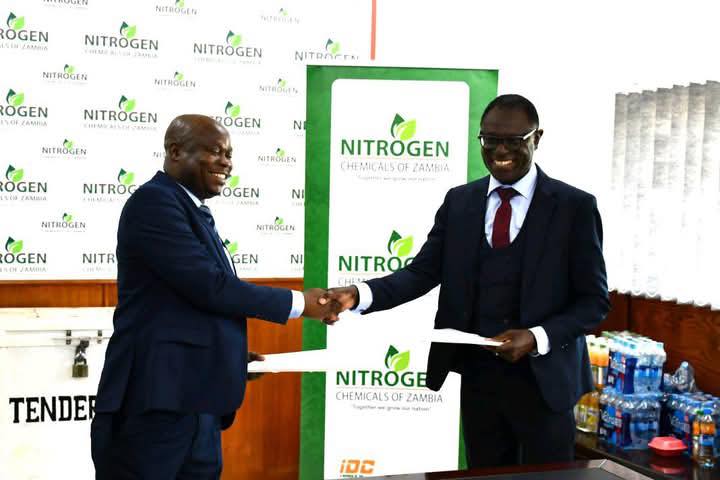
IN A DECISIVE move that signals renewed confidence in Zambia’s tobacco value chain, the Tobacco Board of Zambia (TBZ) has sealed a strategic partnership with Nitrogen Chemicals of Zambia (NCZ).
This is a collaboration poised to ease farmers’ biggest headache: the high cost and limited availability of fertiliser.
The five-year alliance, anchored on local production and crop-specific inputs, could redefine how tobacco is grown, financed and sustained in the country.
Announcing the partnership at the signing of a memorandum of understanding (MoU) yesterday, TBZ executive director Robert Mwale said tobacco remains a critical pillar of Zambia’s agricultural economy, contributing about three percent to the national Gross Domestic Product (GDP).
“Tobacco is one of the contributors to the economy and as the sector grows, so does the ripple effect benefiting growers, transporters and other stakeholders,” Mr. Mwale said, underscoring the crop’s far-reaching impact beyond the farm gate.
At the heart of the TBZ–NCZ collaboration is a shared ambition to lift productivity while lowering costs for farmers. Under the agreement, NCZ will supply crop-specific fertilisers manufactured at its newly commissioned blending plant—inputs designed specifically to meet the nutritional needs of tobacco, rather than the generic fertilisers farmers have long relied on.
For years, the tobacco sector has been weighed down by expensive imported fertilisers, a burden that has squeezed margins and discouraged expansion.
The shift to locally produced, tailored fertiliser is expected to help farmers increase yields, improve leaf quality and cut production costs, restoring confidence in the crop’s profitability.

Mr. Mwale revealed that the partnership directly supports TBZ’s broader strategic vision to grow national tobacco output beyond 100 million kilogrammes by 2028—an ambitious target that hinges on reliable inputs, farmer training and smarter agronomic practices.
“Partnerships like this are critical if we are to achieve our production targets and ensure that farmers truly benefit from the growth of the sector,” he said.
From the manufacturing side, NCZ chief executive officer Chanda Mongo said the company has invested heavily in domestic fertiliser production, recently commissioning two plants—a granulating plant and a blending plant—with a combined annual capacity of 288,000 metric tonnes.
“These plants allow us to move away from a one-size-fits-all approach,” Mr. Mongo said. “We are now producing fertilisers that are tailored to specific crops, including tobacco, to ensure maximum efficiency and profitability for farmers.”
Mr. Mongo added that local production will significantly reduce the costs associated with imports, savings that are expected to trickle down to farmers in the form of more affordable fertiliser and improved access ahead of planting seasons.
“This partnership enables us to provide tobacco farmers with fertilisers that are specifically designed to maximise yields, reduce production costs and grow our economy,” he said.
Beyond numbers and capacity, the TBZ–NCZ agreement represents a broader shift in Zambia’s agricultural policy direction—one that prioritises local value addition, strategic partnerships and farmer-centred solutions.
As fertiliser becomes more accessible and affordable, the real test will be seen in farmers’ fields: healthier crops, better grades and stronger incomes.
If successful, the collaboration could serve as a blueprint for other crop sectors, proving that when regulators and manufacturers work together, agriculture can move from survival to sustainable growth—one harvest at a time.

Woodgate House
Suit 208-209
Cairo Road Lusaka Zambia,
Email: agricoopnews@yahoo.com
Cell: 0955 791 676


.png)




.jpg)